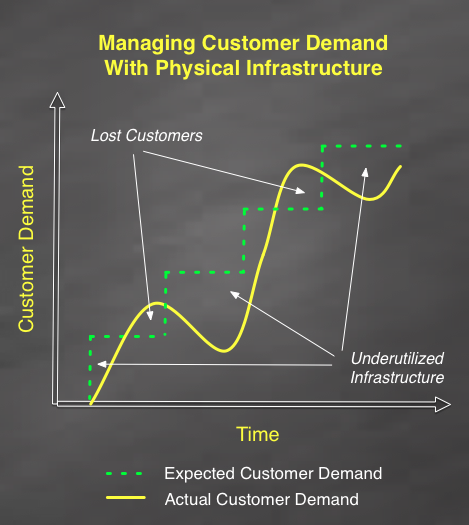
There is an old saying kicking around the cloudosphere that goes like this: "If it shows up on your loading dock, it's not a cloud." The statement is a general disparagement of the private and hybrid "cloud in a box" solutions hardware manufacturers have been promoting. As amusing as we might find the saying, it misleads by focusing on the wrong issue: the hardware. It doesn't take Larry Ellison for us to realize the cloud is actually made up of physical hardware. So I'd like to improve on this saying with this: "If your IT department operates it, it's not a cloud."
I don't have anything against corporate IT... okay, maybe a little something against filling out one too many hardware requisition forms back in the pre-cloud days. But if your cloud runs on your own infrastructure, you have deployed infrastructure ahead of customer demand and are paying for the privilege. The primary value in the cloud is the ability to leverage on-demand capacity of an external provider to align your infrastructure and customer demand. By running your own cloud (a.k.a. Virtualization 2.0), you are betting that your IT department can manage efficiencies comparable to public cloud providers.
This post was a shameless attempt to make use of my 7 day OmniGraffle trial. OmniGraffle: where have you been all my life?
Related Posts: The 5 Stages of Enterprise Cloud Adoption (a.k.a. Grief), Beginning of the End of Shadow IT